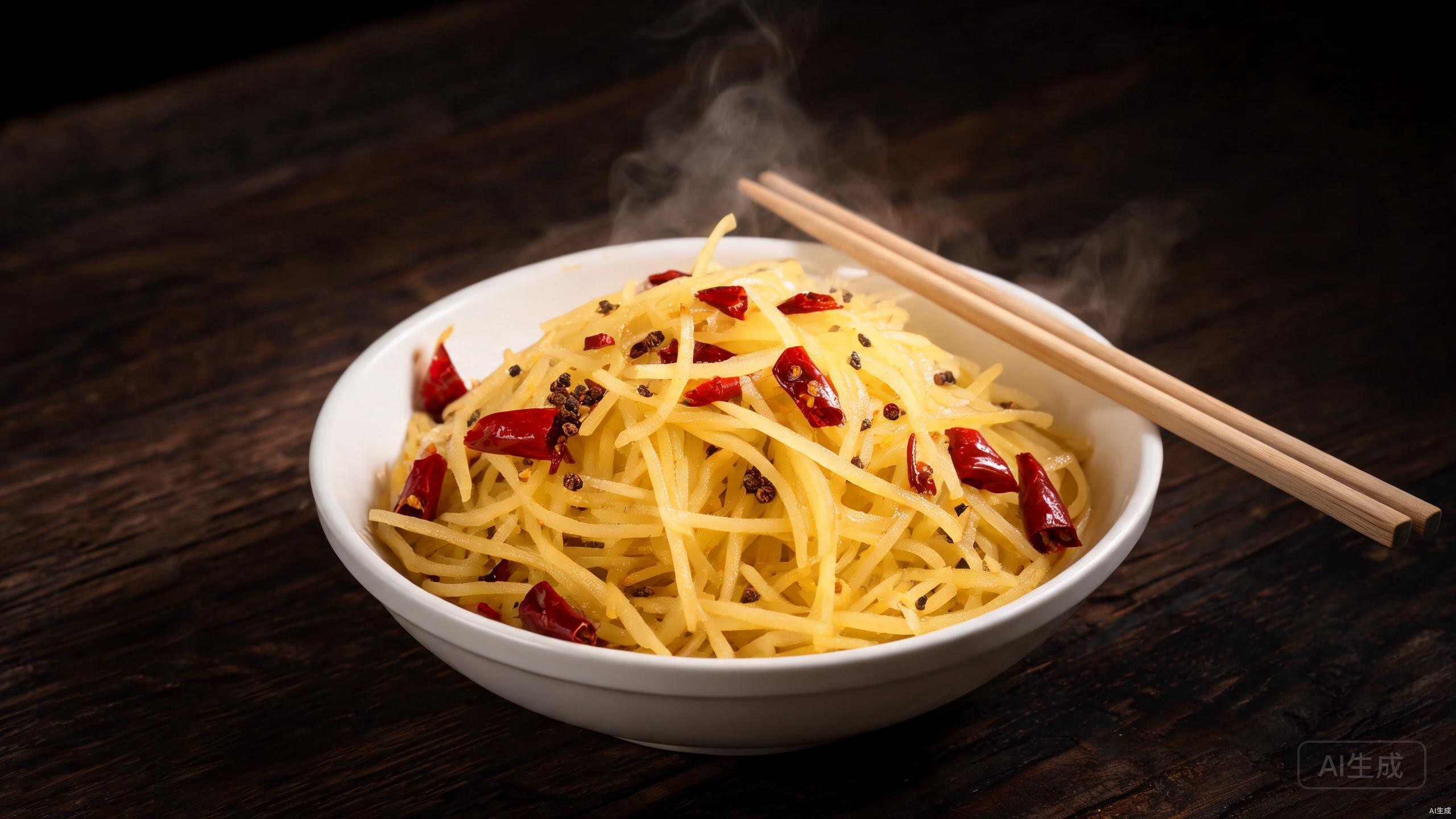
If there is one dish that every Hunan person knows how to make, it is suan la tu dou si (酸辣土豆丝) — hot and sour shredded potato. It is the ultimate everyday side dish: cheap, quick, universally loved, and so simple that it seems like there is nothing to it. But a great suan la tu dou si is harder to make than it looks. The potatoes must be uniformly shredded, thoroughly soaked, and stir-fried over blazing heat so they come out crisp, bright, and snappy — never mushy, never gluey. The balance of hot dried chilies, aromatic black vinegar, and just a hint of sugar is what makes it sing. It is served in every street food stall, every family kitchen, and every restaurant across Hunan. It is not a dish that impresses with complexity. It is a dish that impresses with perfect simplicity.
Suan la tu dou si (酸辣土豆丝) is arguably the most democratic dish in Hunan cuisine. It costs almost nothing to make, requires no special equipment, and takes 15 minutes from start to finish. Every Hunan household has its own version — some add Sichuan peppercorns for numbing heat, some add a splash of light soy sauce, some use fresh chilies instead of dried — but the classic balance of hot (from dried red chilies), sour (from Chinkiang black vinegar), and crunchy (from perfectly cooked potato shreds) is universal. It is the side dish that appears at every family dinner, every street food lunch, and every late-night snack stall. In Hunan, you can tell a good cook by their suan la tu dou si — it is a test of knife skill, heat control, and timing, all packed into five minutes of stir-frying.
In Hot & Sour Shredded Potato, the wok must be smoking hot so the ingredients sear instantly, locking in moisture while developing the smoky wok hei (breath of the wok) that defines Hunan stir-fry. What sets it apart is the layering of the dark vinegar that provides the sour counterpoint essential to Hunan flavor balance, the dried red chilies that provide a different, deeper heat than fresh ones, and the chili oil that is drizzled generously over nearly everything in Hunan. This is the kind of dish that defines Hunan cuisine — fearless in its seasoning and generous in its spirit.
Ingredients
The ingredient list is remarkably short, but the quality of each component matters. Good vinegar makes all the difference, and the right potato variety is essential for that signature crunch.
- Potatoes — 2 medium (about 400 g). Russet or Yukon gold work best. Russets are starchier and become fluffier when cooked, but after thorough soaking they crisp up beautifully. Yukon golds are waxier and hold their shape well. Avoid red potatoes — they are too waxy and do not have the right texture.
- Dried red chilies — the source of heat. Use Sichuan-style dried red chilies or any dried chili you like. The Hunan version is typically made with whole dried chilies cut into sections, not chili flakes or chili oil.
- Chinkiang black vinegar — the soul of the dish. Also called Zhenjiang vinegar. It is dark, aromatic, and slightly sweet, with a depth that white vinegar cannot match. Do not substitute white vinegar — the flavor will be flat and sharp.
- Garlic — thinly sliced, not minced. Sliced garlic browns evenly and adds a nutty aroma.
- Sichuan peppercorns — optional, but classic. They add a subtle numbing, citrusy note that complements the hot and sour flavors perfectly.
- Salt and sugar — salt for seasoning, sugar to balance the vinegar. The sugar should not make it sweet — it should just round out the sourness.
Step-by-Step Instructions
-
Shred the potato and soak in cold water. Peel the potatoes and shred them into thin, uniform matchsticks. Aim for shreds about 2 mm thick — roughly the thickness of a matchstick. You can use a mandoline for perfectly uniform shreds, the large holes on a box grater for a more rustic result, or a sharp knife if you have good knife skills. The most important thing is that the shreds are all roughly the same size so they cook evenly. As soon as you finish shredding, transfer the potatoes to a large bowl of cold water and let them soak for at least 10 minutes. Change the water once or twice until it runs clear.
Why soaking is non-negotiable
Raw potatoes are packed with starch. When shredded potatoes hit a hot wok, that surface starch gelatinizes instantly, turning the potatoes gluey and making them stick together in clumps. Soaking washes away the excess starch so each shred stays separate and crisp. It also prevents browning and keeps the potatoes bright white. If you skip this step, your suan la tu dou si will be mushy and disappointing — no matter how well you stir-fry it.
- Prep the aromatics and seasoning. While the potatoes soak, get everything else ready. Cut the dried red chilies into 2 cm sections with scissors or a knife, and shake out the loose seeds (leave some seeds in if you want more heat). Thinly slice the garlic. Measure the Chinkiang black vinegar, sugar, and salt into a small bowl and stir with a spoon until the sugar and salt are dissolved. Having your seasoning pre-mixed in a single bowl is a pro move — it means you can add everything at once at the end, which is critical for this 5-minute stir-fry.
- Blanch briefly (optional). Drain the soaked potatoes well. For restaurant-quality crispness, bring a pot of water to a rolling boil and add the potato shreds. Blanch for 30 to 45 seconds — no longer. Immediately drain and plunge them into a bowl of ice water to shock them and stop the cooking. This sets the crisp texture and preserves the bright white color. Drain again thoroughly and pat dry with a clean kitchen towel or paper towels. This step is optional — many Hunan home cooks just stir-fry directly from the soak — but it guarantees perfect results every time.
- Stir-fry dry to remove moisture. Heat 2 tablespoons of cooking oil in a wok over the highest heat your stove can produce. Wait until the oil shimmers. If using Sichuan peppercorns, add them now and stir-fry for about 15 seconds until you can smell their citrusy aroma — then fish them out with a slotted spoon if you prefer not to bite into them (or leave them in for authentic texture). Add the dried red chilies and sliced garlic, and stir-fry for 10 seconds until the chilies darken slightly and become fragrant. Watch them carefully — dried chilies burn very quickly, and burnt chilies taste bitter. Then add the well-drained potato shreds. Stir-fry vigorously for 2 to 3 minutes, tossing constantly with your spatula. The goal is to heat the potatoes through and cook off any surface moisture without softening them.
-
Season with vinegar and salt at the end. Pour the pre-mixed vinegar, sugar, and salt sauce over the potatoes. Stir-fry vigorously for another 20 to 30 seconds, making sure every shred gets evenly coated in the glossy, aromatic sauce. Turn off the heat immediately. If using sesame oil, drizzle it over the top and give everything one final toss.
Why vinegar goes in last
Vinegar is volatile — its bright, aromatic compounds evaporate quickly when exposed to high heat. If you add vinegar at the beginning of cooking, most of that lovely, zingy sourness will cook off into the air, and you will be left with a flat, muted acidity. Adding vinegar at the very end, just before you turn off the heat, preserves the full aroma and brightness. The potatoes are still hot, so the vinegar sauce coats them perfectly and the flavors meld together — but it does not cook long enough to lose its character. This is the single most important tip for great hot and sour shredded potato.
- Serve immediately. Transfer to a plate and bring it to the table right away. Suan la tu dou si loses its crispness quickly as it sits, so do not let it hang around. It is typically served as a side dish alongside steamed rice and a main dish like stir-fried pork or fish, but it is also commonly eaten on its own as a quick lunch or a street food snack. The bright, clean, addictive flavors — hot, sour, salty, and just a hint of sweetness — make it the kind of dish that disappears fast.


This dish looks simple, but achieving perfection requires nailing three elements:
- Crispness (脆 — cui). The potatoes must be snappy and firm, with a satisfying crunch. They should not be raw, but they should definitely not be soft. Soaking, high heat, and fast cooking are all essential.
- Sourness (酸 — suan). The sour should be bright and aromatic, not flat or sharp. Good Chinkiang black vinegar and adding it at the very end are the keys.
- Heat (辣 — la). The heat comes from dried red chilies, which provide a slow-burning, aromatic heat rather than the sharp, immediate heat of fresh chilies. The chilies should be fragrant, not burnt.
Substitutions & Adjustments
This is one of the most flexible dishes in Hunan cuisine. Adjust the heat, the sourness, and the add-ins to suit your taste — it will still be delicious.
Less spicy
Use fewer dried chilies, or remove all the seeds. For a completely mild version, omit the chilies entirely and just use a pinch of white pepper for warmth. The dish will still be wonderful — the hot and sour balance just shifts to focus on the sour.
Ingredient substitutes
- No Chinkiang black vinegar: Use balsamic vinegar in a pinch — it is not the same, but it has a similar depth. Apple cider vinegar works too, though it is fruitier. Avoid plain white vinegar — it is too sharp and one-dimensional.
- No dried red chilies: Use chili flakes or a splash of chili oil. Fresh red chilies work too, but they have a different character — brighter, juicier heat instead of the deep, smoky heat of dried chilies.
- Add vegetables: Shredded carrot, thinly sliced bell pepper, or mung bean sprouts are all great additions. Add them with the potatoes for extra color and texture.
- Add protein: This is traditionally a vegetarian dish, but you can add thinly sliced pork or scrambled eggs for a heartier version.
Make ahead
You can shred the potatoes and keep them submerged in cold water in the fridge for up to 24 hours. Change the water once if you can. The actual stir-frying takes only 5 minutes, so cook it right before serving. This is not a dish that reheats well — leftover suan la tu dou si gets mushy and loses its crispness.
Storage
Leftovers keep in the fridge for up to 2 days, but the texture will degrade significantly. Reheat in a hot wok with a splash of oil and a splash more vinegar to try to revive it. Realistically, this dish is best eaten fresh — and given how quickly it cooks, there is no reason not to make it fresh every time.
Nutrition
Estimated values per serving (recipe serves 2). This is a relatively light side dish — most of the calories come from the potatoes and the cooking oil. Serve with rice and a protein for a complete meal.
| Nutrient | Per serving |
|---|---|
| Calories | 220 kcal |
| Protein | 3 g |
| Total fat | 9 g |
| Saturated fat | 1 g |
| Carbohydrates | 32 g |
| Fiber | 4 g |
| Sodium | 480 mg |
| Sugar | 3 g |
Values are estimates based on standard ingredient databases. Actual nutrition will vary depending on the amount of oil you use and the specific type of potato and vinegar.
Frequently Asked Questions
- Wok not hot enough — the oil should be shimmering but not smoking before you add ingredients.
- Overcrowding the wok — cook in batches if needed; too much food at once causes steaming instead of stir-frying.
- Cutting ingredients unevenly — uniform pieces ensure everything cooks at the same rate.
- Adding sauce too early — let the ingredients sear first, then add sauce in the final 30 seconds.
Serve immediately with steamed white rice — the dish should still be sizzling when it reaches the table. A simple soup like egg drop soup or tomato egg soup provides a cooling contrast. For a full Hunan spread, add one cold appetizer and one vegetable dish.
What Makes It Hunan
Hot & Sour Shredded Potato is a quintessential Hunan dish that showcases the bold, unapologetic flavors of Xiang cuisine. Unlike Sichuan's numbing-spicy heat, Hunan cooking relies on dry, direct spiciness from fresh and dried chilies, complemented by the deep umami of fermented ingredients like duojiao (chopped salted chilies) and douchi (fermented black beans).
The hallmarks of Xiang cuisine — dry chili heat, bright acidic tang, and the deep umami of smoke and fermentation — come together in this dish. There is no numbing distraction of Sichuan peppercorn to mask the ingredients; the spice here is meant to be felt and savored.
Whatever the technique, the goal is the same: clean, layered flavors with a clear throughline of chili heat and the savory depth that only slow building — through fermentation, smoking, or patient braising — can produce.
This recipe represents the Hunan preparation. Many Chinese-American restaurant versions of Hunan dishes add extra sugar, use pre-made sauces, or deep-fry ingredients that are traditionally stir-fried. The key difference is that Hunan cooking uses fresh whole chilies, fermented condiments like duojiao and douchi, and high-heat wok techniques — not thick, sweet sauces.
Related Recipes
If you love this quick, vibrant Hunan stir-fry, these other dishes use the same high-heat technique and the same pantry staples.